PH meter for cheese
If you are serious about cheese making you will quickly realise PH (and TA – covered in a separate article) of your dairy products is essential to be successful. So, what does PH meter do? The pH meter measures the difference in electrical potential between a pH electrode and a reference electrode, and so the pH meter is sometimes referred to as a “potentiometric pH meter”.
Although, it does sound very scientific but in a day-to-day usage, it comes down to simply taking the reading of ph meter clearly displayed in a digital form. Until you are close to the set points in your recipe, you are on the winning side.
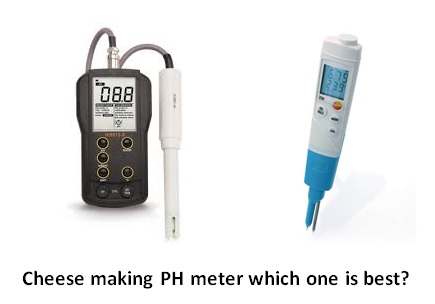
Over the last six years, I have been using both Hanna HI 9813-5 (Two units purchased within 24months) and Testo 206 model (also two sets).
Both brands of ph meters have been fitted with ph probes dedicated to thicker solids and temperature probs.
PH paper:
It’s the most cost-effective way to measure PH of your milk but it does has its major downfalls.
PH paper may come in a roll or pre-cut strips packed in either ‘matches’ style box or a plastic container. I would highly recommend packaging which protects paper from moisture and splashes when stored. The major downfall of PH paper is the fact that readings are not only inaccurate (often to a full point) but also unconclusive. It varies greatly on the operator (or how good the eyesight of the operator is) but also of a light type presented when taking a reading. I have found very different reading when checking against daylight or artificial LED or fluorescent lamps presented in a laboratory room/production space.


I am personally using PH paper to check my brine solution as high saturation of salt and low PH (Acidy) will cause PH probe of your meter go par shape quickly.

Let’s start with Hanna PH meter:
I really like the fact that both temperature and pH probe are on a cord not as a single-handed device. It makes things easy when measuring sample product. You may be surprised how often you will be measuring a cur d ph which means a lot of samples. You want a narrow/tall container to make sure PH probe end is fully ‘submerge’ in a measuring product. Hence, having a probe on a cord make it easier to not tip over the container – like Tiesto does.
- A quick reading from both curds/ liquid and temperature sensors often in less than 10 seconds.
- Probes have been holding reading quite well and I have found only casual re-calibration required.
Downside:
PH probe and temperature probe both were fantastic. Unfortunately, the main hand peace prove to be moisture sensitive and both knob’s for PH regulation failed within 12months. Luckily this issue was fixed in the most recent model which now moist resistant.
Testo 206H meters:
Testo 206 PH meter is one of the old single handed hand peace’s available on the market.
I have found the shape hard to use when measuring small samples in a tall container due to gravity point being very high. Testo seems to tip on a side making a mess and cause to re-sample the same product.
To some of you who will not pasteurise milk but get in pasteurise milk, this may not be a big deal. I have been pasteurising milk to 63deg C and later chilling to a set temperature. When I have been measuring PH at a higher temperature screen often fog-out making impossible to read to scale.
Benefits:
- Pocket size is a plus if you walking into a tight space maturation room often holding a heavy wheel one hand and measuring second.
- Splash resistant (great future when working in a fast peace moving environment with few colleges/employees around you)
- PH probe lasting longer compare with Hanna
Downside:
- The so-called automatic calibration sometimes may take 60seconds or 10min and repeat over and over again. Often, PH meter will properly re-calibrate at PH4 but failed with PH7 buffer. After a failed attempt, you have to start over, which is adding another 5-10min as a hold-up. I have often found a PH meter failing at 5-7 attempts on which time I was prepared to bin the meter.
PH probe required re-calibration on a regular interval (in my case, each 1h or before major step in a cheese making – for example hooping). Sometimes, difference was as high as 0.5!

Wifi probes
Here is an example of a new concept of a wifi probe paired with a mobile phone.
I have never used such set before, therefore my comments are limited. Saying this, I worked for many years in a commercial setup. I wonder how a linked set will deal with thick insulated walls (the so-called sandwich panels) of any small/medium size factory? Also, keeping your mobile phone in a commercial cheese factory/dairy must later or rather sooner end up with a splash or full dip in. I would love to hear comment from anyone who had one.
Few tips which I learned over the years:
- Replace your PH buffers each 6 to 12months (even if you haven’t used those much in that time). It’s a good idea to write a date when PH buffer has been opened in a packaging. As illustrated in the below picture, some manufacturer will not mark lids which can lead to off reading when lid from one buffer will be accidently screwed on a different bottle. Before opening a black Sharpe to mark the lids will sort this out.
- Submerge tip of your PH probe in PH10 buffer at least once a week for around 10min. This will help preserve probe, works really well with Testo meter.

- When dry cleaning, use a liner motion from the end of the probe to the tip. Do not rub with rotation motion as this simply tear in the solid remains in a porous surface of a probe. This truly expand ph probe life if you work with lactic or semi-hard cheeses.
- Never use your PH meter for brine checks. Use a specialty dedicated meter or PH paper. Combination of salt and low ph is deadly for any probe.
- The probe should be stored in a PH friendly solution when un-used (even when seated on your workbench on a production day).

- Sometimes, getting second-hand equipment is very tempting specialty when looking at PH meter heavy price tags. Proceed with caution as you never know how the probe was used (or abused) before and whether it was properly stored.
- The last one is obvious but I feel it’s worth mentioning . Do not leave meter (probe) in a highly moisture environment. After the job is done, take it back to your office and store in a dry/sun off room temp and humid environment.
Happy cheese making!
Lukasz Klekowski
Director
Cheese kettle Pty Ltd