Blogs

Blogs About
Cheesemaking

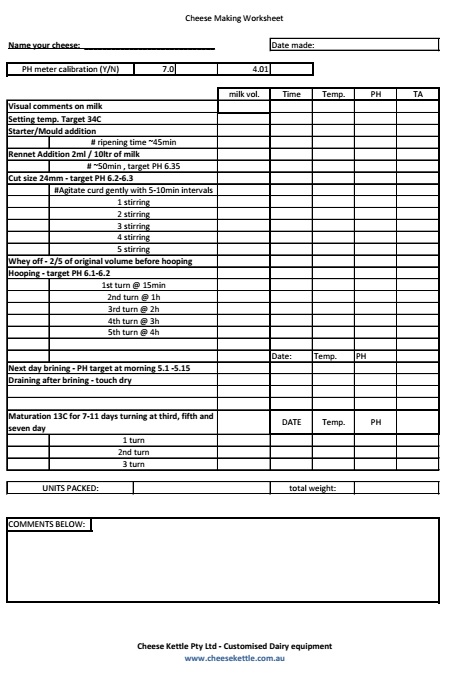
Cheese making worksheet or how other call it make sheet is a step-by-step process of recording your cheesemaking venture.

It’s not needed for cheesemaking as such, however is often an excellent tool. A make sheet is quite a direction, it’s a worksheet you utilize to trace your cheesemaking expertise from begin to end. It includes info about when you created a cheese, the sort of milk you used, what you probably did, and the way you liked the end result.

Fresh cheeses, like mozzarella (often eaten the same day), are created and consumed quickly. however several cheeses have also long process of afinage. Initial they’re made then they’re aged. Cheesemakers often referring to make sheet when grading cheeses down the track. this is often the day after you heat your milk, add culture and rennet, and type your cheese. it should include steps like preparation and cutting the curd, pressing the cheese, and brining or dry salting. The time between the create and consumption the cheese is termed the affinage (French for finishing). A create sheet helps you track what you probably did for the create, the affinage, or both!

I use create sheets to record the milk, culture, and steps I used to make my cheese. My worksheet incorporates a section for the direction and documented (online, that page within which book, or a combination) sections for a way I preserved and finished the cheese (natural rind or waxed?), and one for my comments on however well I liked the result (too salty! must age longer! too ripe!).

You can download example of worksheets here:

– Worksheet PDF – Cheese making worksheet – Cheese Kettle Pty Ltd

– worksheet EXCELL – Cheese making worksheet – Cheese Kettle Pty Ltd

Check out

Our Cheesemaking Recipes!

“Your ultimate beginner’s guide for cheesemaking 101”

Preventing Temperature Drift and Cleaning Delays with a Stainless Steel Milk Tank

Control milk temperature and cut cleaning delays with a stainless-steel milk tank sized for your milk load, milk cooling duty and documented cleaning cycle. A stainless-steel milk tank holds milk temperature more reliably when its chiller matches the incoming milk load and its insulation limits heat gain. Cleaning moves faster when milk residue is removed…

Read More

Sizing a Stainless Steel Milk Tank for Daily Cheese Production and Batch Scheduling

A stainless-steel milk tank should hold the greatest milk volume waiting between milking and the next cheese batch. Size it from your real daily milk flow, batch timetable, temperature control needs and clean-down window. This keeps milk storage matched to production without forcing you to hold more milk than your process needs. Daily Milk Volume…

Read More

Raw Milk Cooling Before Cheesemaking: Choosing a Milk Tank with the Right Chilling and Cleaning Setup

Raw milk should enter a milk tank that provides rapid cooling to the temperature set in your food safety program and holds it there until cheesemaking starts. The chiller and cooling systems must suit your milk volume, starting temperature and filling pattern. Your cleaning setup matters just as much as milk cooling. Milk residue left…

Read More

On-Farm Milk Collection for Cheesemaking: Choosing a Milk Tank for Safe Transport and Short-Term Holding

Choose a milk tank that holds your planned collection, protects chilled milk from heat, supports easy cleaning and empties cleanly into your cheese room. For short-term milk storage, cooling capacity must match your milk temperature, holding time and required milk quality. The dairy equipment setup must also fit the limits in your food safety program….

Read More

    Find Us

    We are here for your! How can we help?

    Your Stainless Steel Partner

    From kettles to pasteurisers, we’ve got you covered. 
Explore our comprehensive range of professional equipment.

    Product Enquiry