

Producing consistent Asiago cheese at commercial scale depends on tight temperature control from whole milk standardisation through curd cooking and pre‑pressing. Using commercial cheese kettles with programmable controls lets you reproduce the same heat curves every time, protecting texture, flavour, and yield for both Asiago Pressato and Asiago d’Allevo.
For Australian makers, this is the difference between experimental success and a reliable product line that can grow beyond a single region or country. This article explains practical temperature profiling for Asiago, how precision controls in kettles support each phase, and how CheeseKettle equipment helps you honour the history and nature of this Italian cheese while working in a modern creamery.
What Is the Origin and Nature of Asiago Cheese?
The name Asiago comes from the Asiago Plateau in the province of Vicenza in northern Italy, where cheese has been produced for centuries. This plateau, with its meadows and pastures, shapes the character of the milk and the tradition behind Asiago cheese as it is known around the world.
Today Asiago is recognised as a Protected Designation of Origin (PDO) cheese, overseen by the Consorzio Tutela Formaggio Asiago, which protects the link between product, area, and method. Within this PDO, Asiago Pressato and Asiago d’Allevo are classified as two main types, considered distinct in texture, age, and the way they are enjoyed.

Why Does Temperature Profiling Matter in Asiago Production?
Temperature profiling matters because Asiago is a semi‑cooked cheese that relies on specific heating stages to manage moisture, acidity, and curd structure. Small errors of only a few degrees over time can shift final moisture and body, giving either brittle, dry cheese or pasty, undercooked curd that does not respond well to touch.
Within the PDO area, producers follow defined ranges that shape the middle and outer parts of the wheel, so the cheese matures as intended. In commercial settings, manually adjusting burners or basic vats makes it hard to stay inside these narrow bands, especially when working with many kg of milk per batch.
How Does Temperature Influence Each Stage of Asiago Cheesemaking?
Asiago production typically begins by warming cow’s milk to a set range for starter addition and rennet, allowing a firm yet elastic curd to form. Holding the milk at this temperature for the right time means the gel will cut cleanly and can be stirred without breaking down.
After cutting, the curd is gently heated in stages while being stirred, which is a defining feature of this type of cheese. The first stage lifts the temperature to an intermediate level, and the second stage takes it to the higher cooking range, each step influencing how the curd releases whey and how the final texture is classified.
Typical temperature‑linked stages:
- Milk ripening and rennet addition at a stable warm point
- Curd firming before cut at the same temperature as setting
- First cook to a middle range to start whey removal
- Second cook to final target for the intended style and age
What Does an Effective Asiago Temperature Profile Look Like?
An effective profile sets clear targets, ramp speeds, and holding times that suit your milk composition, cultures, and the type of Asiago you want to produce. For younger Asiago Pressato you usually keep more moisture, while Asiago d’Allevo is produced with a profile that supports longer ageing and a firmer body.
Most make schedules raise the curd in two main heating stages, each managed in a controlled way rather than by eye. The precise temperatures and times you use will influence not just moisture, but how the cheese feels when pressed by hand and how it behaves in the middle after months of maturation.
Illustrative temperature stages:
- Ripening and setting phase: low to mid‑30s °C
- First cook: gentle rise to an intermediate cooking temperature
- Second cook: steady increase to the final cooking temperature for your selected style
Example Asiago Temperature Schedule
| Stage | Typical Target | Purpose |
|---|---|---|
| Milk Ripening & Rennet | Low–mid 30s °C | Support coagulation and early acid formation |
| Curd Firming (Pre‑Cut) | Same range | Achieve clean break and resilient gel |
| First Cook / Half‑Cook Start | Higher middle °C | Begin whey expulsion and firming |
| Second Cook / Final Heating | Upper target °C | Set final moisture and body |
| Moulding / Pre‑Press Holding | Warm room range | Maintain activity before pressing and brine |
How Do Precision Kettles Improve Temperature Control for Asiago?
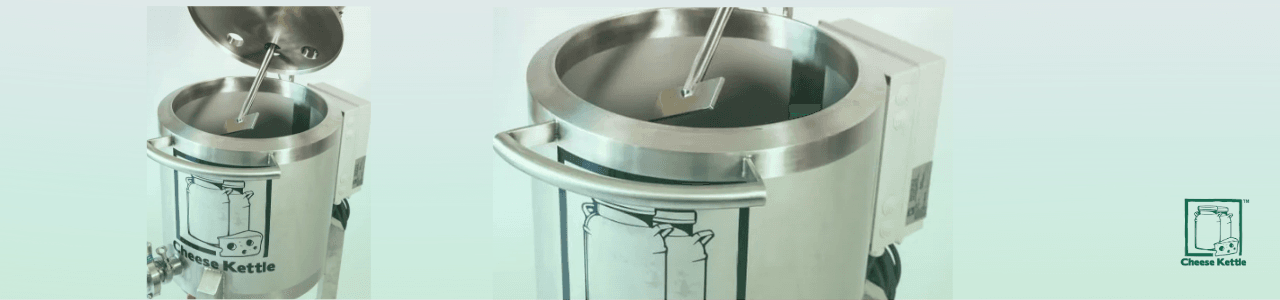
Commercial cheese kettles use jacketed heating and control systems to warm milk and curd evenly, without hot spots or scorching. This way, every kilogram of milk in the vat experiences similar treatment, supporting the consistency expected from Asiago cheese products.
CheeseKettle’s 200 Ltr Cheese Making Kettle Vat is designed for even heating, with stainless steel construction, integrated agitation, and precise temperature settings suited to medium‑scale production. For sites that use standard power rather than three‑phase, the 240V Single Phase Cheese Vat offers a practical way to achieve similar control across different regions of Australia.
How Can You Program a Practical Asiago Temperature Profile?
Programming starts with writing your current method in detail: temperatures, times, and stirring stages from milk intake to moulding. Each step is then entered into the kettle controller as a combination of target temperature, rate of change, and hold time, so the profile becomes a dependable way of working rather than an individual habit.
For instance, you might program a first step that raises the curd from setting temperature to a middle cooking point over a set period, followed by a second step that reaches the final cooking temperature. After a few runs, you adjust these settings in small amounts to fit your desired yield, texture, and the way the curd feels to the touch at each stage.
Practical programming tips:
- Keep ramp speeds gentle so curd is not stressed by sudden heat
- Connect agitator speed changes to specific heating stages
- Add alarms for key checks such as cut size, pH, or free whey appearance
- Name profiles clearly, for example by type, batch size, or season
How Do Temperature and pH Work Together in Asiago Production?
Temperature and pH work together because warmth encourages starter cultures to turn lactose into acid, changing the condition of the curd. If the curd is cooked faster than the acid curve, the cheese can become rubbery; if acid drops too far while the curd is still very moist, the final body may become brittle.
For Asiago, which is produced under PDO rules, getting this balance right means matching the heating curve with planned pH points over time. In practical terms, that means tracking pH at repeated stages and then tuning temperature holds rather than changing only culture dose or make time.
How Do Curd Size, Agitation, and Temperature Work Together?
Curd size and agitation determine how quickly heat and whey movement affect each curd particle. Smaller pieces with stronger stirring will lose whey faster, while larger pieces with gentle movement hold more moisture and give a softer texture in the middle.
In Asiago cheesemaking, it is common to cut to nut‑sized pieces and refine size further during stirring and cooking. A Cheese Harp matched to your vat helps you keep cut size consistent, and controlled agitation means each curd particle gets similar treatment, whatever the batch size in kg.
How Can You Validate and Refine Your Asiago Temperature Profile Over Time?
Validation means proving that your programmed profile gives the same quality every time, not just in a single batch. To do this, hold your profile steady for several makes, recording yield per kg of milk, pH at set points, and how the cheese looks and feels before and after ageing.
If the cheese is too moist, you might slightly raise the final temperature or extend the last heating step. If it is too dry or firm, you may shorten the final hold or reduce the top temperature, always changing only one factor at a time so the effect is clear.

How Do CheeseKettle Vats Support Practical Asiago Production in Australia?
CheeseKettle’s 200 Ltr Cheese Making Kettle Vat supports precise temperature profiling for both Asiago Pressato and Asiago d’Allevo, in a size that suits many artisan and growing commercial makers. Its design gives you a reliable way to use your make information from traditional methods within a modern, controlled system.
For sites without three‑phase power, the 240V Single Phase Cheese Vat offers a straightforward way to add this level of control without major electrical upgrades. When combined with a Cheese Harp, Cheese Making Press in custom sizes, and a brine tank scaled to your daily output in kg, you gain a complete line from raw milk through to ready‑to‑age wheels.
Typical integrated setup:
- Precision kettle or vat for controlled heating and agitation
- Harp and tools for consistent cutting and curd handling
- Press and brine system sized to daily Asiago cheese production
Conclusion: How Can Precision Temperature Profiling Support Your Asiago Line?
When you align temperature profiling, pH control, curd handling, and brining, Asiago becomes a manageable and repeatable product that still reflects its origin on the Asiago Plateau. You gain more control over yield, texture, and flavour, and a clearer way to train your team and share information across shifts and seasons.
Ready to refine your Asiago cheese production in a practical, structured way? Contact CheeseKettle today about the 200 Ltr Cheese Making Kettle Vat or 240V Single Phase Cheese Vat to build a stable, repeatable temperature profile for Asiago, from the first litre of milk to every finished wheel leaving your creamery.