
Blogs

Blogs About
Cheesemaking

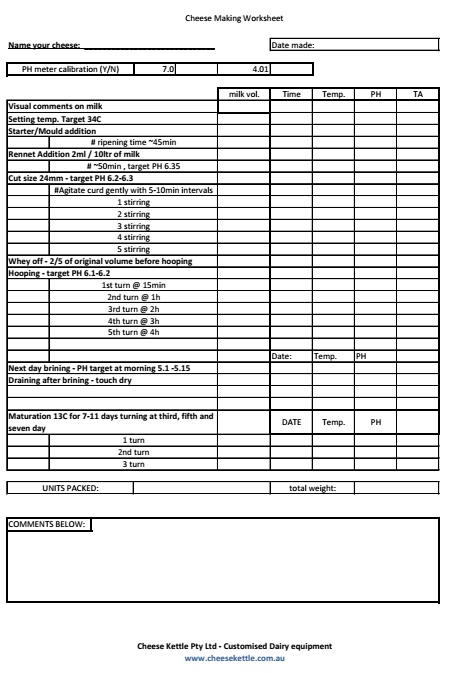
Cheese making worksheet or how other call it make sheet is a step-by-step process of recording your cheesemaking venture.

It’s not needed for cheesemaking as such, however is often an excellent tool. A make sheet is quite a direction, it’s a worksheet you utilize to trace your cheesemaking expertise from begin to end. It includes info about when you created a cheese, the sort of milk you used, what you probably did, and the way you liked the end result.

Fresh cheeses, like mozzarella (often eaten the same day), are created and consumed quickly. however several cheeses have also long process of afinage. Initial they’re made then they’re aged. Cheesemakers often referring to make sheet when grading cheeses down the track. this is often the day after you heat your milk, add culture and rennet, and type your cheese. it should include steps like preparation and cutting the curd, pressing the cheese, and brining or dry salting. The time between the create and consumption the cheese is termed the affinage (French for finishing). A create sheet helps you track what you probably did for the create, the affinage, or both!

I use create sheets to record the milk, culture, and steps I used to make my cheese. My worksheet incorporates a section for the direction and documented (online, that page within which book, or a combination) sections for a way I preserved and finished the cheese (natural rind or waxed?), and one for my comments on however well I liked the result (too salty! must age longer! too ripe!).

You can download example of worksheets here:

– Worksheet PDF – Cheese making worksheet – Cheese Kettle Pty Ltd

– worksheet EXCELL – Cheese making worksheet – Cheese Kettle Pty Ltd

Check out

Our Cheesemaking Recipes!

“Your ultimate beginner’s guide for cheesemaking 101”

Milk Standardisation for Paneer: Adjusting Fat and SNF for Consistent Block Firmness in Small Dairies

Paneer is a fresh cheese from the Indian subcontinent, made by curdling hot milk with an acidic agent such as lemon juice or white vinegar. For small dairies, standardising fat content and Solids-Not-Fat (SNF) in cow milk or buffalo milk is the key to getting the same texture every batch. This is what turns variable…

Read More

Designing a Small‑Batch Mascarpone Line: From Milk Reception to Packing Flow

Designing a small batch mascarpone line is a lot like planning your best homemade mascarpone recipe from scratch, only on a commercial scale. You still want that creamy texture, completely smooth mixture, and delicious soft taste, but now every step from milk and cream reception through packaging has to be consistent, safe, and easy for…

Read More

Achieving Halloumi’s High Melting Point: Curd Handling and Temperature Management for Consistent Results

Getting halloumi to brown and stay in shape on a grill or pan depends on how you manage curds, whey, and heat at every step of the whole process. When you handle the curds gently, cook them at the right temperatures, and control brine and pressing, you can rely on a firm, semi-hard cheese that…

Read More

Designing a Compact Pressing Area for Ricotta Salata: Draining Tables, Racks, and Effluent Management

A compact pressing area for ricotta salata has one focus: helping you turn fresh ricotta into a firm, mildly salty cheese with a crumbly texture and rich flavour without wasting space. You want a corner that keeps whey under control, supports safe cheesemaking, and produces a balanced, traditional cheese you can grate over pasta dishes,…

Read More

    Find Us

    We are here for your! How can we help?

    Your Stainless Steel Partner

    From kettles to pasteurisers, we’ve got you covered. 
Explore our comprehensive range of professional equipment.

    Product Enquiry