

Proper curd cutting with a cheese harp directly controls Colby moisture content and maximises cheese yield by creating uniform particle sizes that release whey consistently. Poor cutting technique leads to uneven moisture distribution, reduced yield through curd fines, and quality defects that shorten shelf life. Most Australian cheese makers struggle with moisture control because they underestimate how curd size impacts the final 38-40% moisture target required for quality Colby.
What Makes Curd Cutting Critical for Colby Moisture Control?
Curd size determines surface area exposure, which directly governs whey expulsion rates and final moisture content in Colby cheese. Smaller curd particles create more surface area for syneresis, resulting in drier cheese, while larger pieces retain more moisture. Medium moisture cheeses like Colby require ½ cm cube cuts to achieve the target 38-40% moisture range that delivers the mild and creamy flavour this cheese is known for.
The cutting process initiates syneresis, the expulsion of whey from the curd matrix, which functions like water leaking from a cut sponge. Uniform cutting ensures consistent moisture distribution throughout the vat, preventing wet spots that promote bacterial growth or dry areas that create crumbly texture defects. Large curd sizes produce higher moisture cheese than smaller cuts, making precision essential for meeting the maximum 40% moisture standard for quality Colby.

Critical Factors in Curd Cutting
Particle uniformity: Consistent ½ cm cubes ensure even syneresis across the entire batch
Cutting timing: Proper gel firmness at cutting prevents excessive fines or trapped moisture
Surface area ratio: Smaller cuts increase whey drainage; larger cuts retain moisture for Colby’s characteristic texture
Temperature control: Maintain 31-32°C during cutting to support optimal protein network contraction
How Does a Cheese Harp Deliver Superior Cutting Precision?
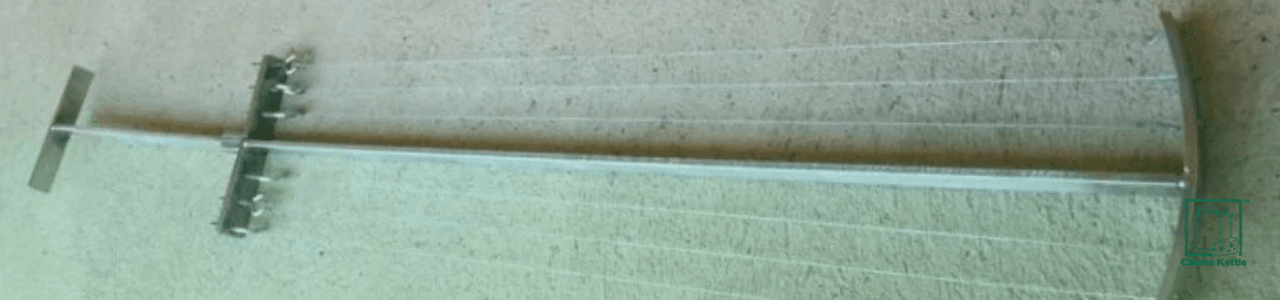
A cheese harp features parallel stainless-steel wires spaced at precise intervals that cut through the entire curd mass simultaneously, creating uniform particles that standard knives cannot achieve. Custom-made harps match your vat dimensions exactly, ensuring complete coverage without dead zones where uncut curd hides. The wire spacing, typically 12-13mm for Colby production, determines final particle size and corresponding moisture content.
The vertical-then-horizontal cutting pattern creates three-dimensional uniformity essential for consistent Colby quality. First, pull the harp vertically through the length of the vat to create columns. Second, rotate 90 degrees and cut vertically again across the width. Third, angle the harp to make horizontal cuts through the depth, completing the cube formation. This systematic approach prevents the random particle sizes that occur with knife cutting alone.
What Cutting Technique Optimises Colby Yield?
Proper cutting timing when curd reaches optimal firmness reduces yield loss from curd fines while maintaining target moisture levels. Cutting gel too early when insufficiently firm leads to lower yield through increased fine particles and fat loss in the whey. Delayed cutting produces firmer curd that collapses less during the process but traps excessive moisture, exceeding Colby’s 40% maximum standard.
Cutting intensity, including duration, rotation speed, and cycle frequency, affects final curd size and moisture retention. Continuous cutting without pause pushes curds ahead of blades without further size reduction, creating irregular pieces with inconsistent drying rates. The cycle-cut-rest-cut pattern allows curd to settle between passes, enabling the harp wires to slice cleanly rather than tear protein networks that are essential for quality cheese making.
Cutting Variable | Impact on Moisture | Impact on Yield |
|---|---|---|
Smaller particle size (8-10mm) | Reduces moisture 2-4% | Increases fines loss 5-8% |
Optimal size (12-13mm) | Maintains 38-40% target | Maximizes retention 95-97% |
Larger particles (15mm+) | Increases moisture 3-5% | Minimal fines but quality defects |
Continuous cutting | Variable moisture pockets | High fines loss from shattering |
Cycle cutting (3-4 passes) | Uniform moisture distribution | Optimal yield preservation |
Why Does Wire Spacing Matter for Moisture Targets?
Wire spacing on your cheese harp controls the initial particle size, which sets the foundation for all subsequent moisture management during cooking and washing. CheeseKettle’s custom-made cheese harps feature adjustable wire spacing to match specific cheese styles and moisture requirements. For Colby’s 38-40% moisture target, 12mm spacing creates ideal ½ cm cubes after the three-directional cutting sequence.
Different cheese varieties demand different initial cuts because their target moisture levels differ significantly. Hard Italian cheeses use 3-4mm spacing to create rice-sized particles for their low 30-32% moisture content. Traditional Colby requires moderately sized cuts that balance moisture retention with adequate whey drainage to achieve its semi-hard classification, ensuring the mild flavour and open texture that distinguish it from cheddar cheese.
How Do You Execute the Perfect Three-Cut Sequence?
The vertical-horizontal-angle cutting pattern ensures complete curd mass transformation into uniform cubes without creating irregular fragments. Start with the harp positioned at one end of the vat with wires running parallel to the short dimension. Draw the harp smoothly through the entire length at consistent speed, approximately 30 seconds per pass, to create vertical columns extending through the curd depth.
Rotate the harp 90 degrees and repeat the vertical cutting motion perpendicular to the first cuts, forming a checkerboard pattern when viewed from above. For the crucial third dimension, tilt the harp at 30-45 degree angles and make multiple passes to slice horizontally through the curd depth. This angled approach prevents the harp frame from interfering with complete depth penetration that straight horizontal positioning creates in most vat designs.
Essential Cutting Steps
Check gel firmness: Clean break test shows clear whey separation at the cut edge
First vertical pass: Draw harp lengthwise through vat in 30-second smooth motion
Second vertical pass: Rotate 90° and cut across vat width at same pace
Angled horizontal cuts: Tilt harp 30-45° for 3-4 passes through curd depth
Rest period: Allow 3-5 minutes for curd settlement before gentle stirring begins
What Role Does the Swiss-Style Curd Cutter Play?
Swiss-style curd cutters offer specialized cutting geometry designed for traditional Alpine cheese varieties but adapt effectively for Colby when precise dimensional control matters. These cutters feature fixed blade spacing that creates specific curd dimensions required for consistent moisture outcomes. The rigid frame design provides stability during cutting that prevents the wire flexing common in standard harps when processing firm gel.
The mechanical advantage of Swiss-style cutters becomes apparent in larger commercial vats where hand-drawn harps require significant operator strength and fatigue leads to inconsistent cutting speed. Precision cutting for consistent results remains the primary benefit regardless of vat size. For Australian cheese makers scaling from artisan to commercial production, Swiss-style cutters maintain the uniformity achieved during smaller batches when processing 200+ litre vats.
How Does Cutting Impact Overall Cheese Yield?
Optimal curd cutting maximizes the protein and fat retained in cheese while minimizing losses to whey, directly affecting profitability per litre of milk processed. Reducing cutting firmness variability through timing optimization significantly reduces yield variation between batches. Since milk production accounts for over 90% of cheese manufacturing’s environmental footprint, maximizing yield also reduces impact per kilogram of cheese produced.
The relationship between curd size and yield operates through two competing factors: syneresis efficiency versus fines generation. Properly sized ½ cm cubes for Colby release whey at optimal rates during the 90-minute cooking phase without excessive protein breakdown. Oversized particles trap whey pockets that later drain during pressing, creating moisture migration and texture defects that affect the final creamy cheese quality.
Typical Yield Outcomes by Cutting Quality:
Optimal cutting technique: 9.5-10.2 kg Colby per 100 kg milk (95-97% theoretical yield)
Irregular particle sizes: 8.8-9.4 kg per 100 kg milk (88-92% theoretical due to fines loss)
Delayed cutting (overfirm gel): 9.0-9.6 kg per 100 kg milk (moisture defects reduce saleable yield)
Early cutting (weak gel): 8.2-9.0 kg per 100 kg milk (excessive fines and fat loss to whey)
What Common Cutting Mistakes Reduce Colby Quality?
Rushing through the cutting sequence creates irregular particle sizes that produce moisture gradients within the finished cheese, leading to premature spoilage and shortened shelf life. The most frequent error involves incomplete horizontal cutting that leaves large curd masses in the vat bottom, which retain excessive moisture and create soft, weak body texture. Colby’s higher moisture content compared to cheddar already creates structural weakness; irregular cutting compounds this by producing cheese that develops bitter flavors and becomes extremely soft within 100 days.
Excessive cutting cycles attempting to achieve perfect uniformity shatter curd particles and generate yield-robbing fines while liberating fat globules into the whey. Mechanized cheesemaking demonstrates how cutting intensity and stirring speed affect curd grain size and shattering rates. Three to four deliberate cutting cycles with settling periods between passes achieve superior results compared to continuous cutting or excessive manipulation during the making process.
Cutting Errors to Avoid
Inconsistent cutting speed: Variable harp movement creates mixed particle sizes with uneven moisture retention
Skipping horizontal cuts: Leaves large bottom-vat pieces that cause moisture defects and pressing problems
Cutting before proper gel firmness: Weak curd shatters into yield-reducing fines and fat loss
Over-manipulation: Excessive passes break protein networks, releasing fat and creating paste texture
Inadequate rest periods: Immediate stirring after cutting doesn’t allow syneresis to begin at cut surfaces
How Do You Verify Optimal Cutting Results?
Visual assessment of curd uniformity immediately after the cutting sequence provides the first quality checkpoint before proceeding to cooking. Properly cut Colby curd displays consistent ½ cm cube shapes throughout the vat depth without visible large chunks or excessive fine particles floating in the whey. Scoop curd from multiple vat locations (front, middle, back, and bottom) to ensure three-dimensional uniformity that photographs of surface curds alone cannot reveal.
The settling test offers quantitative feedback on cutting precision and gel firmness at cutting. After completing all cutting passes, stop all agitation and observe the curd for 2-3 minutes. Properly cut curd of optimal firmness settles uniformly to the bottom third of the vat with clear whey separation. Excessive fines create cloudy whey, indicating over-cutting or premature gel cutting that will affect the final mild and creamy flavour profile.
What Equipment Preparation Supports Consistent Cutting?
Proper cheese harp sanitization and inspection before each use prevents contamination while ensuring the tool performs at peak precision. CheeseKettle’s stainless steel harps require thorough cleaning with food-grade alkaline detergent followed by acid rinse to remove mineral deposits that affect wire tension. Inspect each wire for proper tension by plucking wires like guitar strings to identify loose ones that flex during cutting and create oversized particles.
Temperature control of the curd mass before cutting significantly impacts gel firmness and cutting performance. Colby recipes typically call for cutting at 31-32°C, which provides sufficient gel strength while preventing the brittleness that occurs at lower temperatures. Verify vat temperature at multiple depths using a calibrated thermometer since temperature stratification creates firmness variations that lead to inconsistent cutting results even with correct harp technique.

When Should You Choose a Cheese Harp vs. Curd Knives?
Cheese harps excel when producing Colby and other moisture-sensitive varieties where particle uniformity directly determines quality and yield outcomes. The parallel wire design cuts the entire curd mass to identical dimensions in seconds, an impossibility with sequential knife passes that process small vat sections individually. Australian commercial cheese makers processing 200+ litre batches particularly benefit from harps’ efficiency and consistency compared to the 15-20 minutes required for manual knife cutting of equivalent volumes.
Curd knives retain value for small artisan batches under 50 litres where the investment in custom-fitted harps exceeds budget constraints. Knives also provide advantages when making fresh cheeses like fromage blanc or ricotta that require gentle cutting to preserve delicate curd structure. For established operations focused on Colby, Monterey Jack, and similar washed-curd varieties, custom-made harps from CheeseKettle deliver the precision required for consistent moisture control and maximum yield.
Tool Type | Best Application | Particle Uniformity | Cutting Speed | Ideal Batch Size |
|---|---|---|---|---|
Cheese Harp | Colby, washed-curd varieties | Excellent (±1mm variance) | 3-5 minutes complete | 100-500+ litres |
Swiss-Style Cutter | Traditional Alpine, precise dimensions | Superior (±0.5mm variance) | 4-6 minutes complete | 200-1000+ litres |
Curd Knives | Fresh cheese, small artisan batches | Good (±3mm variance) | 15-20 minutes | 20-100 litres |
Wire whisk (breaking) | Soft-ripened, high-moisture varieties | Variable (intentional) | 5-8 minutes | Any size |
What Advanced Techniques Fine-Tune Moisture Outcomes?
Adjusting cooking temperature and time after cutting provides the secondary moisture control that compensates for minor cutting variations and adapts to milk composition differences. Increasing cooking temperature by one degree decreases cheese moisture, while decreasing by one degree increases moisture retention. For Colby targeting 39% moisture, raising cook temperature from 38°C to 39°C typically reduces final moisture by 0.5-1.0 percentage points while preserving the creamy flavour.
The washing step unique to Colby production offers additional moisture adjustment opportunity while removing lactose that would otherwise create acid development during aging. After reaching target cook temperature, drain whey to 2.5cm above the curd surface and add cold water at 36°C, typically 50% of the original milk weight. This dilutes whey, halts acid development, and creates the mild, sweet flavor profile distinguishing Colby from sharper mild cheddar varieties that family members often prefer for sandwiches and snacking.
How Does Proper Cutting Extend Colby Shelf Life?
Uniform moisture distribution achieved through precise cutting prevents the localized high-moisture pockets where spoilage bacteria colonize and create quality defects. Higher moisture content leads to weak body and reduced aging potential, with typical recommendations to store and consume within three months due to bitter flavor development and excessive softening after 100 days. Consistent 38-40% moisture throughout the cheese wheel extends this window by preventing moisture migration that accelerates deterioration.
The reduced bacterial growth risk in properly made Colby stems from uniform moisture below 42% across all cheese areas. Foodborne bacteria grow less readily in semi-hard cheeses with moisture content under 50%. Irregular cutting that creates wet zones elevates localized moisture above safe thresholds despite average readings meeting specifications, creating food safety vulnerabilities in otherwise compliant cheese that could affect your purchasing decision and brand reputation.
How Does Traditional Colby Differ from Modern Variants?
Traditional Colby originated in Colby, Wisconsin in 1885 when Joseph Steinwand developed the washing process that distinguishes it from cheddar cheese. The technique involves draining whey during cooking and replacing it with cold water to halt acid development. This creates Colby’s characteristic mild flavour and open texture compared to the sharper, more compact structure of aged cheddar.
Modern variants like Colby Jack combine Colby with Monterey Jack in a marbled pattern, offering visual appeal for slicing and melting applications. These products maintain the same moisture targets and cutting requirements as traditional Colby to ensure consistent quality. Whether making classic Colby for grating over nachos or Colby Jack for convenience in sandwiches, the fundamental cutting principles remain identical to achieve optimal moisture and yield.

What Makes Colby Perfect for Australian Cheese Makers?
Colby’s mild and creamy characteristics appeal to Australian consumers seeking approachable cheese flavors for everyday cooking and snacking. The shorter aging period compared to traditional cheddar reduces storage requirements and accelerates cash flow for commercial operations. Market demand for mild, creamy cheese continues growing as families add versatile options to their weekly shopping.
The open texture and high moisture content make Colby ideal for melting applications in recipes ranging from toasted sandwiches to baked pasta dishes. Australian cheese makers can differentiate their product range by offering this Wisconsin-originated style alongside standard cheddar varieties. Proper cutting technique ensures your Colby delivers the consistent quality that builds customer loyalty and repeat purchases at your store or farmers’ market.
Conclusion
Mastering cheese harp and curd cutting technique transforms Colby production from inconsistent results to reliably profitable yields with extended shelf life. The ½ cm cube particle size achieved through systematic three-direction cutting provides the foundation for moisture control between 38-40%, while proper timing at optimal gel firmness maximizes protein and fat retention for superior yield outcomes.
Ready to achieve consistent Colby quality with professional-grade equipment? Contact CheeseKettle today about our custom-made Cheese Harp designed to fit your specific vat dimensions and deliver the uniform cutting precision that optimizes moisture control and maximises yield in every batch.